

Blog
Why Are Some Musicians Turning Away from Spotify?
4 Feb '2026
As streaming reshapes how music is consumed, why are a growing number of artists are questioning the world’s most influential platform?
Cover Photo by David Pupăză on Unsplash
Spotify has remained the dominant force in music streaming for quite a long-winded stint now. In Q3, 2025, the platform reported around 713 million monthly active users—281 million of which were premium users. And, these figures have reliably grown each year at an average rate of 11–12%. The streaming titan’s annual revenue rose by around 18% in 2024, With the company announcing it had paid more than $10 billion in royalties to rights holders in 2025. That’s significantly more than any other streaming platform competing.
Yet despite Spotify’s monopolistic grip on the music industry, 2025 saw a noticeable wave of musicians publicly distancing themselves from the platform. While Spotify’s user base continues to expand, a growing number of artists (those providing the goods)—particularly independent, experimental, and alternative musicians—are doubting the platform’s cultural, political, and economic values, taking an active stance to oppose it.
This article will examine the blatant juxtaposition between Spotify’s more-than-happy listeners and their pretty-darn-furious artists, dissecting the debate around artist compensation, corporate ethics, and the future of music in an era dominated by streaming.
A New Wave of Boycotts
Throughout 2025, we saw a swathe of artists boycott the service, announcing their decision to strip their catalogues from Spotify. Unlike previous high-profile departures, these moves largely came from independent musicians, unfolding like a domino effect—one after the next.
In February 2025, Chad VanGaalen, the Canadian indie, folk, and electronic artist, was amongst the multitude of artists who rebelled, announcing a removal of their music from major streaming platforms. He wrote bluntly, “I have asked for [my music’s] removal because Spotify/Apple/Amazon are mediocre lazy demon level weirdos.” While the phrasing was characteristically idiosyncratic, the message resonated widely among independent artists disillusioned with major platforms. VanGaalen’s music remains available on Bandcamp, intending to sustain a more traditional, personal and loyal relationship with his fans.
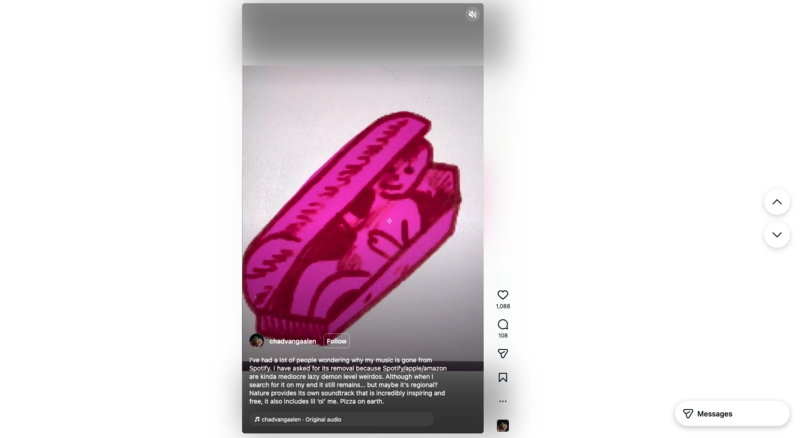
Elsewhere, other independent folk and experimental acts followed suit. These include: Deehoof and Kadhja Bonet. However, their main gripes are with the ethical concerns of the company, rather than its depriving indie artists of funds and commercial greed. While these removals barely make a dent in Spotify’s vast catalogue, they signal a growing cultural unease, particularly among musicians, where earning income is already more difficult than in most industries.
Older Boycotts
This is not the first time artists have walked away from Spotify. In 2022, we saw Neil Young take his music down from the platform. At the time, that was in protest of Spotify’s exclusive deal with The Joe Rogan Experience. Young explicitly accused Rogan and Spotify of spreading COVID-19 misinformation, adding a further layer to the controversy. Joni Mitchell followed suit soon after, framing her decision as an act of solidarity.
"For legacy artists with vast cultural capital, withdrawal can be symbolic; for most musicians, it is economically risky"
Both artists returned their catalogues to Spotify in 2024, once Rogan’s podcast ceased exclusivity, marking a firmly held stance, true to their initial boundary. Their return highlighted a key reality of Spotify boycotts: for legacy artists with vast cultural capital, withdrawal can be symbolic. Yet, unfortunately for most musicians, it’s economically risky and not an option. Most indie artists feel completely at the mercy of the Spotify overlords.
Still, these high-profile cases established a precedent, resulting in Spotify no longer being viewed solely as a neutral or even innocent distributor of music. Rather, they’re reframed as a political and cultural platform whose business decisions are consistently provoking ethical objections. These rebellious stances are empowering, and lead us to ask: Will Spotify eventually plummet into demise?
Daniel Ek’s Investments in Helsing
In 2025, ethical scrutiny intensified following Daniel Ek (Spotify’s CEO)’s investments in Helsing. Why was this controversial? Because Helsing is a European defence technology company specialising in AI-driven military systems. Ek was red-handedly caught investing €100 million in 2021, followed by a further €600 million more recently.
Helsing has described its mission as purely defensive, stating its technology is deployed “to European countries for deterrence and for defence against the Russian aggression in Ukraine only.” Ek himself has come forth arguing that modern warfare is increasingly shaped by AI, saying, “The world is being tested in more ways than ever before… it’s really now AI, mass and autonomy that is driving the new battlefield.”
Musicians who see their work as anti-war or politically progressive, and who advocate for world peace, have struggled with the idea that the profits generated by their music may indirectly be used to enrich huge military technology firms. Several artists removing their catalogues in 2025 explicitly cited Ek’s investments as a reason, framing their decisions as moral rather than financial.
Massive Attack—the Trip Hop pioneers from Bristol UK—were the first act with a major label to remove their work from Spotify in protest to Ek’s investments, stating, “the economic burden that has long been placed on artists is now compounded by a moral and ethical burden, whereby the hard-earned money of fans and the creative endeavours of musicians ultimately funds lethal, dystopian technologies”. A wise selection of words put forward against an unfortunately dystopian possibility.
Royalties
Artist compensation itself remains the most persistent criticism of Spotify, where even non-musicians have some collective awareness of the financial neglect. On average, the platform pays between $0.003 and $0.005 per stream, placing it among the lowest-paying major streaming services, de-revolutionising how musicians get paid. Apple Music, by comparison, pays roughly double per stream on average, though its overall user base is far smaller.
This issue has also prompted boycotts before. Taylor Swift famously withheld her music from Spotify in its early years, arguing that the platform devalued music, removing the essence of art itself, demotivating the artists. Thom Yorke of Radiohead is also known to have removed some of his solo projects due to the same issue. However, both artists have since added their music back, offering little follow-up commentary. Could this be another example of submission to the elite corporate entity?
Credit: omid armin
In 2014, funk band Vulfpeck released Sleepify—an album composed entirely of silent tracks—inciting fans to play it overnight on repeat to maximise profits. In the end, the project generated an estimated $20,000 before Spotify removed the album for violating its terms of service. The stunt became a landmark moment in the debate over streaming economics.
ICE Ads
Spotify faced additional backlash in 2024 after ICE recruitment advertisements were reportedly played to unpaid users in the United States. While this controversy led primarily to user boycotts, some artists also took it upon themself to act accordingly, responding by removing their music in protest.
Mexican rock band Café Tacvba and hardcore group Saetia both cited the ads as reasons for leaving the platform, arguing that their music shouldn’t be associated with immigration enforcement messaging. This underscored how advertising decisions, particularly on a free, ad-supported platform, can entangle artists in political messaging they don’t consent to, and certainly don’t align with ethically.
AI Music Training
Concerns around artificial intelligence have skyrocketed since its rise to global prominence. Since a recent update, Spotify’s user agreement grants the company rights to “reproduce, modify, create derivative works from” and otherwise use uploaded content from its artists. This strategically forces users to sign over even more of their rights to the corporation, and while this type of thing is commonplace across big tech companies, it’s raised fears that music could be exploited to train generative AI systems without explicit consent.
Photo by Aerps.com on Unsplash
High-profile artists, including Dua Lipa, Sir Elton John, and Sir Paul McCartney, have sternly spoken out against AI firms using copyrighted music to train models without payment or permission. Daniel Ek has stated that AI should support human creators rather than replace them, but most take Ek’s words with a pinch of salt, seeming as Spotify’s actions haven’t exactly aligned thus far.
In some part favourable to Spotify regarding this particular matter—unlike YouTube, Meta, or TikTok—the platform doesn’t currently label AI-generated music. Because of this, there are relatively few documented cases of artists leaving the platform explicitly due to AI, indicating the issue remains more of a looming concern with potential to escalate than an immediate threat.
Piracy
Unlike film and television, the music industry operates within a tightly consolidated streaming market. This makes streaming music more convenient to listeners, reducing the amount of overall piracy. From that perspective, the streaming era has brought something positive to the table.
Whereas movies and TV shows are licensed exclusively to individual platforms, forcing consumers to juggle multiple subscriptions. This dynamic has pushed some viewers back toward piracy over recent years.
Photo by Michael Geiger on Unsplash
In the music industry, through digital distributors, artists often release music to all major platforms simultaneously—reducing labour and increasing widespread potential. Consequently, the competition doesn’t revolve around who has the content, but rather who offers the best service (defined by price and overall features of service). This is how Spotify has leveraged such a highly held position consistently, dominating the industry without fear of losing subscribers. Simply put, it does offer the best and most convenient service to listeners all around.
So whilst Spotify is favoured by the fans, who the artists depend on to put food on the table, the artists don’t stand much of a viable chance at shifting the climate. That’s why artists, rather than listeners, are more likely to leave Spotify, and why their departures rarely disrupt the platform’s growth.